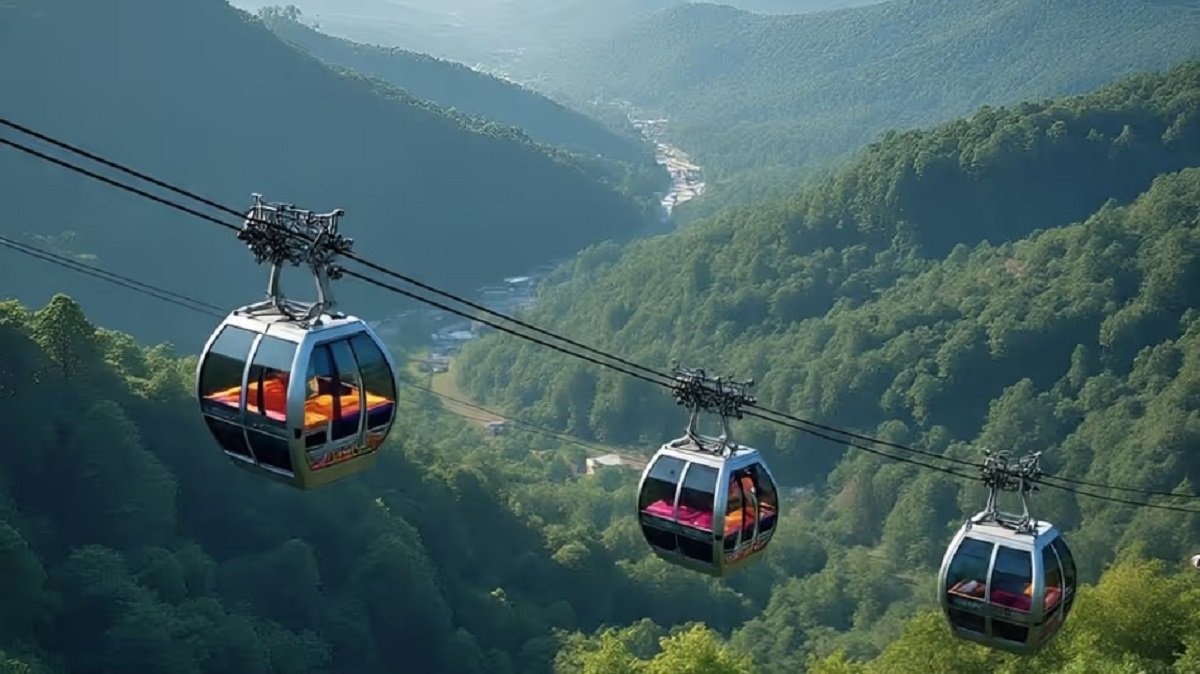
The proposed Shillong Peak Ropeway Project has emerged as one of Meghalaya’s most contentious development debates, with opposition from local residents and political parties growing even as the state government remains firm on implementing the project.
At the center of the controversy is the Joint Action Committee (JAC) Against the Shillong Ropeway Project, led primarily by women protesters who have been staging demonstrations and an indefinite sit-in since November 6. The protesters fear the Rs 151-crore project could threaten the ecologically sensitive catchment areas and drinking water sources around Lum Shyllong.
While opposition to the project has become increasingly visible on the streets, a parallel narrative has gained traction online, where many residents have voiced support for the ropeway, viewing it as a tourism booster and a solution to traffic congestion. However, these supporters have yet to organize public demonstrations in favor of the project.
Despite mounting pressure, the Meghalaya government has ruled out scrapping the project, which is scheduled for completion by 2028. Officials insist that all environmental clearances and assessments were conducted before approval and maintain that the project site is located about 3.15 kilometers away from the sacred Shillong Peak.
The government has also cited national guidelines that recognize passenger ropeways as environmentally friendly modes of transport and claims that the project’s infrastructure will occupy only a minimal portion of the catchment area without affecting natural water springs.
The controversy has increasingly taken on political overtones, with the Voice of the People Party (VPP) and the Congress backing the anti-ropeway movement.
VPP president Ardent Miller Basaiawmoit warned the NPP-led MDA government against attempting to suppress the women-led agitation. He stated that the party could be compelled to actively join the movement if the government continued what he described as efforts to intimidate protesters.
Basaiawmoit argued that Lum Shyllong plays a crucial role in preserving water resources for Shillong and surrounding areas and said residents’ concerns should not be ignored. He emphasized that development projects should proceed only with public consent and cautioned the government against dismissing the voices of affected communities.
Support for the JAC has continued to expand, with delegations from the Hynniewtrep Youths’ Council (HYC) Women’s Wing, the VPP State Youth Wing, and residents of Khanduli in Jaintia Hills visiting the protest site to express solidarity.
The HYC Women’s Wing criticized the treatment of protesters during a recent confrontation near the Secretariat and raised concerns about elderly women being removed from protest sites.
Meanwhile, the VPP Youth Wing challenged the government’s claim that the project would have only a minimal environmental impact. Party leaders pointed to plans for supporting infrastructure, including restaurants, guest rooms, leisure facilities, and parking areas, arguing that the project’s footprint could be much larger than officially stated.
The group also questioned the felling of hundreds of trees and warned that damage to catchment areas could have long-term consequences for water security and ecological balance.
Residents from Khanduli also rejected the government’s proposal to constitute another expert committee, arguing that similar panels in the past had failed to address major public concerns effectively.
While maintaining that they are not opposed to development or ropeways in principle, they insisted that Lum Shyllong, considered both sacred and environmentally sensitive, is not an appropriate location for the project.
The residents urged the government to relocate the ropeway to an alternative site that would safeguard water sources and preserve the ecological heritage of future generations.
With government leaders refusing to back down and opposition groups broadening their support base, the Shillong Ropeway controversy appears set to remain a major political and environmental flashpoint in Meghalaya.