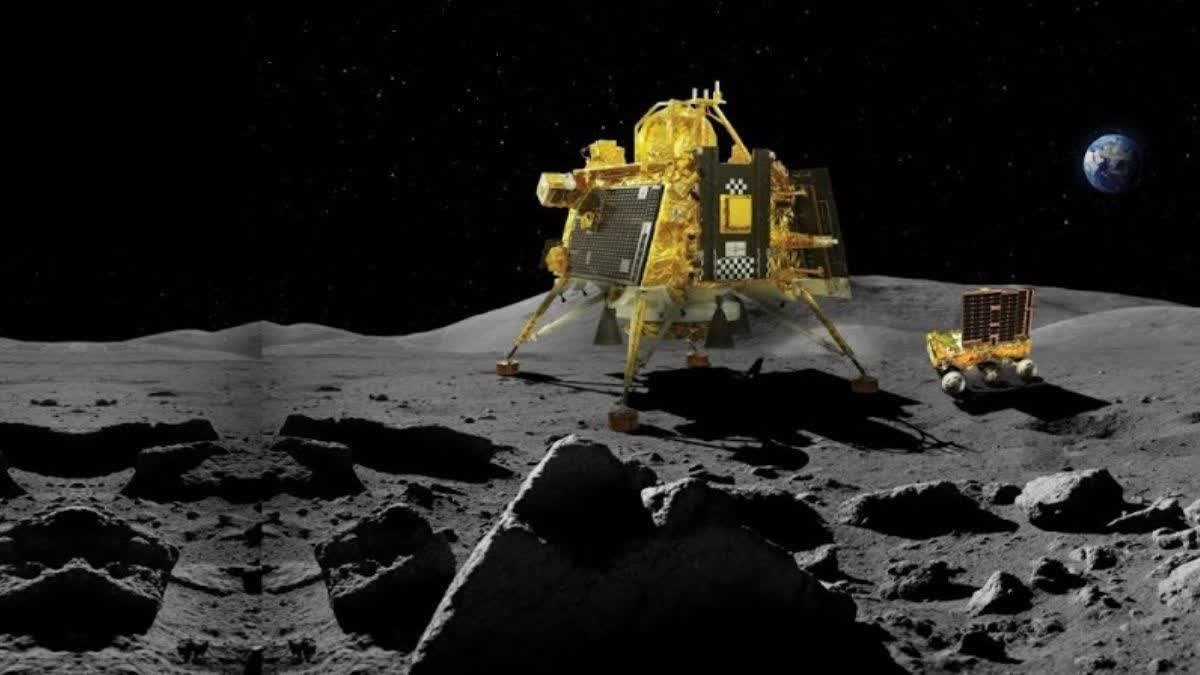
Indian Space Research Organization is preparing for an ambitious new phase of lunar exploration with plans to bring soil and rock samples from the Moon back to Earth under the proposed Chandrayaan-4 mission by 2028. The announcement was made by Prakash Chauhan during a programme in Bhopal on Thursday. According to Chauhan, the mission will involve an advanced robotic system capable of landing on the lunar surface and collecting natural samples of lunar soil and rocks using a mechanical arm before transporting them back to Earth for scientific research and analysis.
Scientists believe the mission could significantly enhance understanding of the Moon’s geology, mineral composition, and evolutionary history. Alongside Chandrayaan-4, ISRO is also progressing with Chandrayaan-5, a collaborative mission between India and Japan Aerospace Exploration Agency aimed at conducting detailed exploration of water, ice, and mineral resources near the Moon’s south pole. Under the joint mission, ISRO will develop the lunar lander while the Japanese agency will build a more advanced and powerful rover for surface exploration.
India’s lunar programme has steadily expanded over the past two decades. The historic Chandrayaan-1 mission, launched in 2008, played a major role in confirming the presence of water molecules on the Moon for the first time. Although the lander component of Chandrayaan-2 experienced a hard landing, its orbiter continues to provide valuable scientific data, including information about ice deposits in permanently shadowed craters near the lunar south pole.
In 2023, India achieved a historic milestone through Chandrayaan-3 by becoming the first country to successfully land a spacecraft near the Moon’s south pole. With Chandrayaan-4 and Chandrayaan-5 now under development, ISRO aims to further strengthen India’s position as a major force in global space exploration and lunar science.