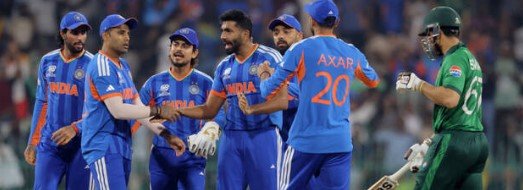
India asserted its absolute dominance in the T20 World Cup 2026 with a resounding 61-run victory over arch-rivals Pakistan at the R. Premadasa Stadium in Colombo on Sunday, February 15. In a high-stakes Group A encounter that doubled as a tactical masterclass, India posted a formidable 175/7 on a surface that offered significant grip for spinners. The charge was led by a breathtaking 77-run assault from opener Ishan Kishan, who navigated early setbacks to dismantle the Pakistani bowling attack. Captain Suryakumar Yadav, contributing a steady 32, later praised the team’s unwavering commitment to their “aggressive brand of cricket.” Following the win, which officially secured India’s spot in the Super 8 stage, Suryakumar dedicated the triumph to the fans back home, stating, “This is for India,” and emphasizing that the team’s ability to “think outside the box” under pressure was the defining factor in their performance.
For Pakistan, the evening was one of historical milestones but ultimate frustration. Under the leadership of Salman Ali Agha, the team leaned heavily into a spin-centric strategy, delivering a record-equaling 18 overs of spin in a single T20 World Cup innings. Despite early success with the wicket of Abhishek Sharma for a duck, Pakistan’s bowlers struggled to contain Kishan’s relentless counter-attack. The chase never found its rhythm, as Jasprit Bumrah and Hardik Pandya struck early to reduce Pakistan to a precarious 13/3. While Usman Khan offered some resistance with a top score of 44, the disciplined Indian attack—featuring two-wicket hauls for Bumrah, Pandya, Axar Patel, and Varun Chakravarthy—bundled Pakistan out for a mere 114 in 18 overs. The defeat leaves Pakistan in a precarious third-place position in Group A, trailing the USA on Net Run Rate and facing a must-win scenario in their upcoming clash against Namibia to remain in the tournament.
In the post-match presentation, Pakistan skipper Salman Agha remained composed, urging his team and fans to look at the “big picture” rather than dwelling solely on the immediate sting of the loss. Agha admitted to lapses in execution, particularly during the powerplay, but defended his spinners’ efforts on a “tacky” wicket that he believed played better in the second innings. He noted that in high-emotion games of this magnitude, tactical blunders can be magnified, but stressed that the tournament is far from over. With a critical game looming in just two days, Agha emphasized the need for his side to reset and treat the Super 8s as a “new tournament” once qualification is secured. As India prepares to fly to Ahmedabad for their final group match against the Netherlands, the contrast in camp morale is stark: one side is celebrating a statement win for the nation, while the other is searching for the tactical clarity needed to survive a world-stage exit.