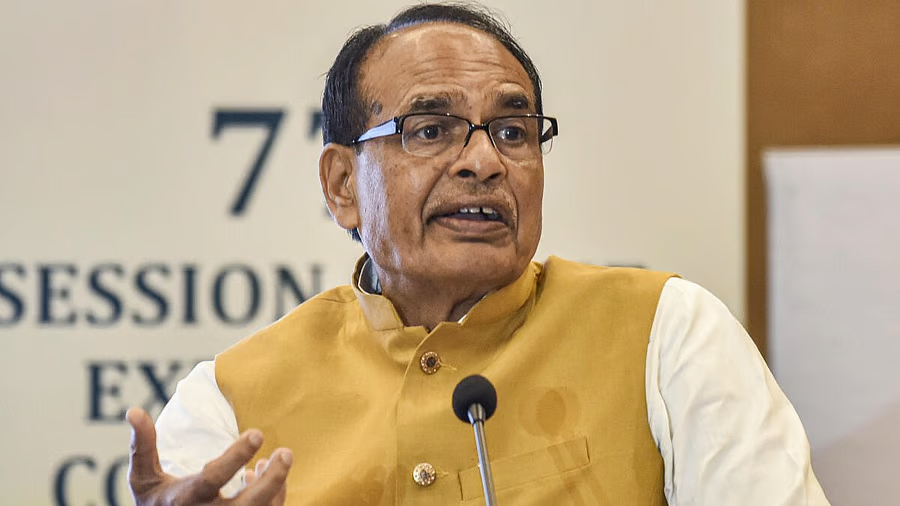
Union Agriculture Minister Shivraj Singh Chouhan has ignited a fresh political debate by asserting that secularism is not a core element of Indian culture and that socialism is no longer necessary for the country. His remarks, delivered during a public event in Varanasi commemorating the 50th anniversary of the Emergency, come amid renewed calls from the Rashtriya Swayamsevak Sangh (RSS) to review the inclusion of the terms “secular” and “socialist” in the Preamble of the Indian Constitution.
Speaking from the stage, Chouhan stated, “Bharat mein samajwad ki zaroorat nahi hai. Dharmanirapeksh hamari sanskriti ka mool nahi hai aur is par vichar hona chahiye” (There is no need for socialism in India. Secularism is not the core of our culture and this must be deliberated upon).
He argued that India’s civilisational ethos is rooted in ‘Sarva Dharma Sambhav’—equal respect for all religions—and that the country’s pluralistic traditions predate the constitutional insertion of secularism during the Emergency period (1975–77). Citing ancient scriptures and Swami Vivekananda’s teachings, Chouhan emphasized that Indian philosophy naturally embraces inclusivity without the need for imported ideological labels.
On socialism, the minister contended that Indian values such as “Jiyo aur jeene do” (Live and let live) and “Sarve Bhavantu Sukhinah” (May all be happy) already reflect a deeply embedded social vision, rendering the term “socialism” redundant in the constitutional context.
Chouhan’s comments follow a statement by RSS general secretary Dattatreya Hosabale, who called for a national review of the two terms, arguing they were added during a period when democratic institutions were suspended. Union Minister Jitendra Singh echoed similar sentiments, stating that the original Constitution drafted by Dr. B.R. Ambedkar did not include these words.
The remarks have drawn sharp criticism from opposition parties. Congress leaders accused the BJP and RSS of attempting to undermine the Constitution’s foundational principles, while Samajwadi Party veteran Rajendra Chaudhary labeled the statements as anti-democratic.
As the debate intensifies, political observers suggest that the issue could become a flashpoint in the lead-up to future legislative sessions and elections, with ideological narratives taking center stage in national discourse.