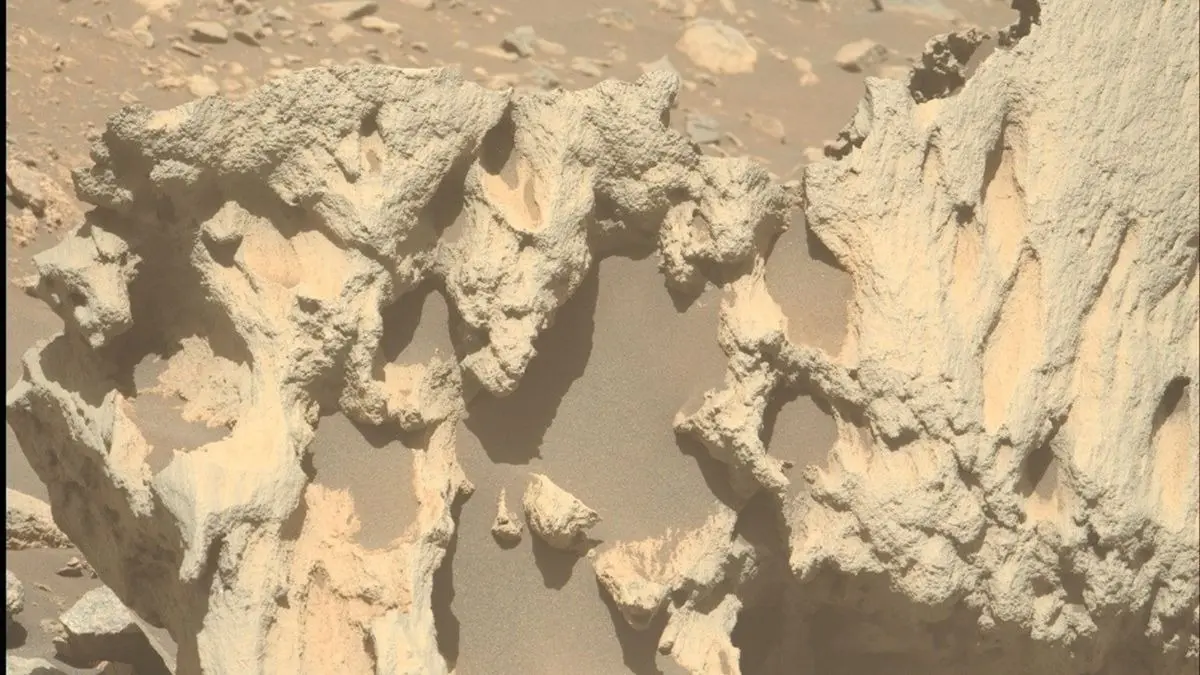
NASA’s Perseverance rover has made a landmark discovery on Mars, identifying what appears to be its first meteorite since landing in Jezero Crater more than four years ago. The find, announced by scientists this week, marks the first suspected meteorite detection by Perseverance in nearly five years of exploration.
The unusual boulder, nicknamed Phippsaksla, was spotted on September 2, 2025 (mission Sol 1612) near the Vernodden region outside Jezero’s rim. Standing out from the surrounding terrain, the rock measured about 80–81 cm in length and displayed a glossy, sculpted surface unlike the flatter, fragmented Martian rocks nearby.
Initial images captured by the rover’s Mastcam-Z camera drew attention to the rock’s distinct texture and color. Follow-up analysis using SuperCam laser and spectrometers revealed a composition rich in iron and nickel—a hallmark of metallic meteorites formed in other parts of the solar system.
Meteorite hunting is considered a secondary mission for Perseverance, whose primary objectives include searching for signs of ancient microbial life and collecting rock cores for a future sample return mission. However, the discovery of Phippsaksla adds to the rover’s scientific achievements and aligns it with earlier Mars missions, such as Opportunity and Curiosity, which also encountered space rocks during their explorations.
Researchers believe that studying meteorites on Mars can provide valuable insights into the planet’s geological history and the broader dynamics of the solar system. The find underscores the diversity of materials present on the Martian surface and offers a rare opportunity to examine extraterrestrial rock in situ.
Perseverance continues to operate in Jezero Crater, advancing NASA’s long-term goal of preparing for a sample return mission that could bring Martian material back to Earth for detailed study.