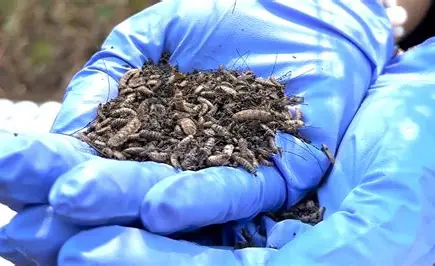
A groundbreaking artificial intelligence technique is poised to revolutionize forensic investigations in violent crime cases by improving the accuracy of time-of-death estimations. Developed by a research team led by organic chemist Rabi Musah at Louisiana State University, the method combines machine learning with chemical analysis to identify insect species from puparial casings—remnants left behind by blowflies that colonize human remains.
Blowflies are among the first organisms to arrive at a crime scene involving a corpse, laying eggs that develop into larvae and eventually adult flies. These insects leave behind puparial casings, which can persist for years and serve as biological evidence. However, different species of blowflies mature at varying rates, making species identification critical for accurate forensic timelines.
The new technique uses AI-driven pattern recognition to analyze the chemical fingerprints of these casings. By training machine learning models on known samples, researchers can now rapidly and reliably determine the species involved, even long after decomposition has occurred. This advancement allows forensic experts to back-calculate the time of death with greater precision, especially in cases where traditional methods fall short due to delayed discovery.
According to Musah, “The ability to identify species from puparial casings using chemical signatures and AI could significantly improve forensic reconstructions, particularly in cold cases or remote crime scenes.”
The implications of this technology extend beyond time-of-death estimation. It may also help investigators infer the location of death, environmental conditions, and post-mortem movement of remains. As nearly 70% of homicide cases involve delays between the crime and body recovery, this tool could become a vital asset in criminal justice systems worldwide.
The research team is currently working on expanding the database of chemical profiles and refining the AI models for broader application. Law enforcement agencies and forensic labs are expected to begin pilot testing the technique in select jurisdictions over the coming year.