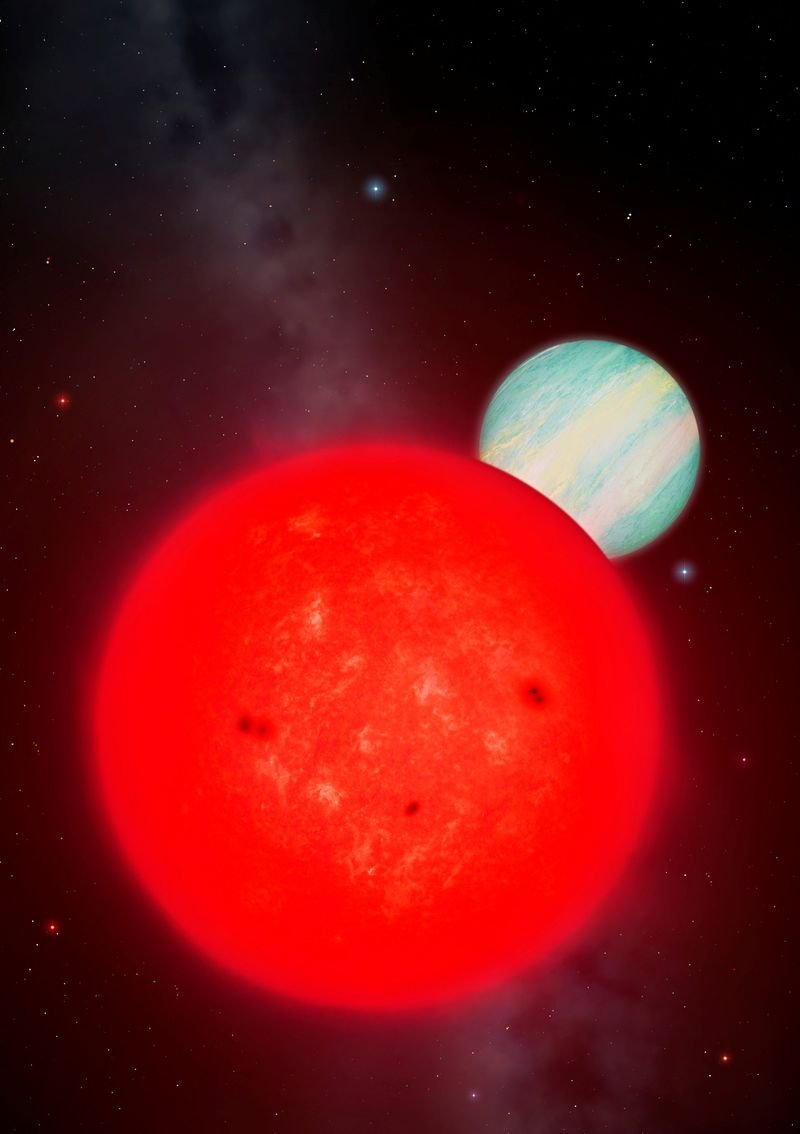
Astronomers have discovered a giant gas planet orbiting a tiny red dwarf star, defying existing theories of planetary formation. The star, TOI-6894, is only 20% the mass of the Sun, yet it hosts TOI-6894b, a planet as large as Saturn. This unexpected pairing has left scientists puzzled, as small stars typically form rocky planets rather than gas giants.
The discovery, made using NASA’s TESS space telescope and confirmed by ground-based observations, challenges the widely accepted core accretion model of planet formation. According to this model, planets form from protoplanetary disks surrounding young stars. However, smaller stars have less material available, making it difficult for them to form large gas giants.
Scientific Implications
The existence of TOI-6894b suggests that alternative formation mechanisms may be at play, such as gravitational instability, where a planet forms rapidly from collapsing gas and dust. Scientists are now re-evaluating their understanding of planetary evolution, questioning whether low-mass stars can host more gas giants than previously thought.
Unusual Characteristics
Unlike most hot Jupiters, which have scorching temperatures, TOI-6894b is strangely cold, adding another layer of mystery to its formation. The planet orbits its star in just three days, making it one of the fastest-orbiting gas giants discovered.
This discovery opens new avenues for exoplanet research, prompting astronomers to search for similar anomalies in other star systems. Could there be more unexpected planetary pairings lurking in the cosmos? Scientists are eager to find out.