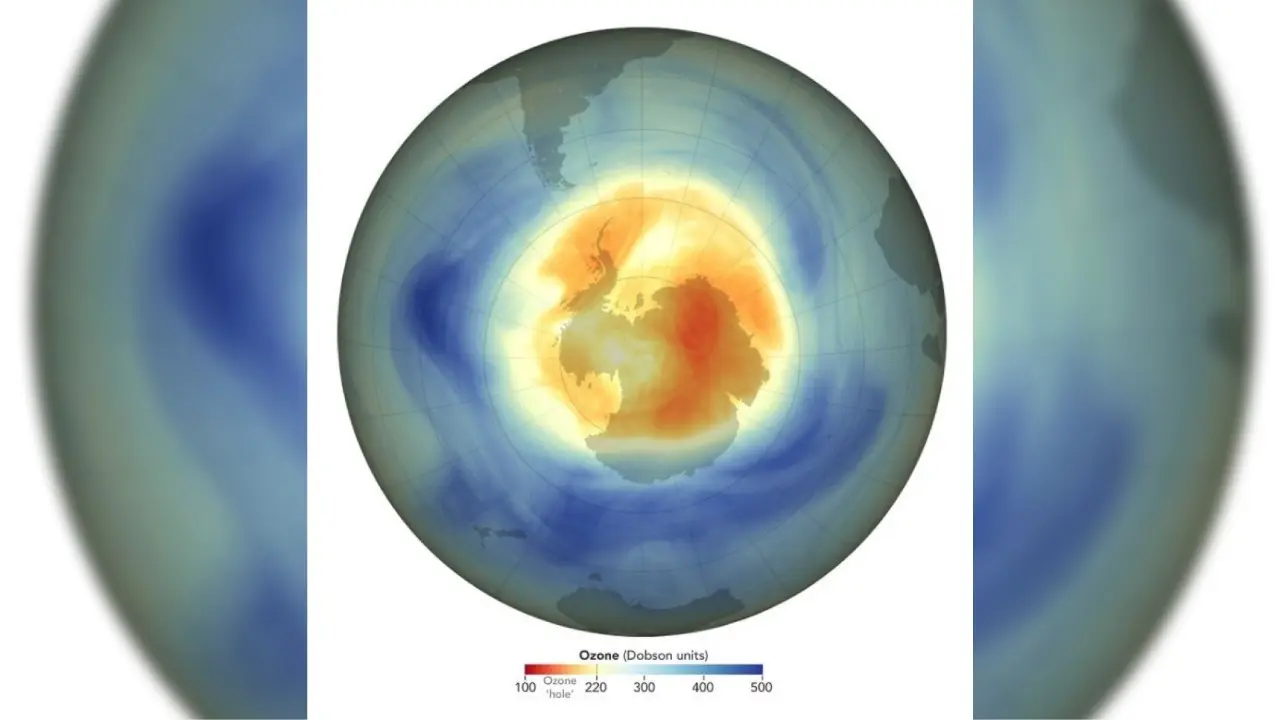
The annual assessment of the Antarctic ozone hole has revealed encouraging progress, with scientists reporting that the 2025 ozone hole was the fifth smallest since 1992. The findings, released jointly by the National Oceanic and Atmospheric Administration (NOAA) and NASA, confirm that international efforts to phase out ozone-depleting substances are yielding long-term results.
According to the analysis, the ozone hole reached its largest one-day extent in early September 2025, measuring 8.83 million square miles. This figure is about 30% smaller than the record peak observed in 2006, when the hole reached its most severe size. On average, the hole measured 7.23 million square miles during the season, underscoring a steady trend of improvement.
Scientists attribute the shrinkage to the success of the Montreal Protocol, the landmark 1987 international treaty designed to eliminate the use of chlorofluorocarbons (CFCs) and other ozone-depleting chemicals. While remnants of these banned substances remain in older products such as insulation and landfills, their gradual decline has allowed the ozone layer to begin healing.
Experts project that, with continued adherence to the Montreal Protocol and its amendments, the ozone layer could recover to 1980s levels by the late 2060s. Natural atmospheric variability also plays a role in annual fluctuations, but the overall trend remains positive.
Paul Newman, chief scientist for atmospheric science at NASA’s Goddard Space Flight Center, noted that lower stratospheric chlorine levels prevented the 2025 hole from being significantly larger. “We are seeing the direct benefits of international cooperation and sustained policy action,” he said.